R32 Skyline GT-R: The Complete Guide
Built to win one specific championship, it won all of them. The R32 is the smallest, lightest and most analogue Skyline GT-R, the car that earned the Godzilla nickname, and the only one every American can now legally import.
Last updated 4 September 2026 · Written by the GTR MAFIA TOKYO team.
- The specification
- Why the R32 exists: a rulebook, read carefully
- The RB26DETT and its six throttle bodies
- ATTESA E-TS and Super-HICAS
- 29 straight wins, and Bathurst
- Where the name Godzilla came from
- V-spec, V-spec II, N1 and Nismo
- Why the R32 is the most analogue GT-R
- The 25-year rule and 2014
- Riding an R32 in Tokyo
The specification
| Chassis code | BNR32 |
|---|---|
| Production | August 1989 – November 1994 |
| Units built | Approximately 43,900 |
| Engine | 2,568 cc RB26DETT — twin-turbocharged DOHC 24-valve straight-six, iron block |
| Induction | Six individual throttle bodies; twin ceramic-rotor turbochargers |
| Quoted power | 280 PS at 6,800 rpm (Japan's voluntary advertising ceiling; real output was higher) |
| Quoted torque | 353 Nm at 4,400 rpm |
| Gearbox | Five-speed manual |
| Drivetrain | ATTESA E-TS all-wheel drive, rear-biased, up to 50% torque forward |
| Steering | Super-HICAS four-wheel steering |
| Wheelbase | 2,615 mm |
| Kerb weight | Around 1,430 kg |
| Market | Japan, plus small official allocations to Australia, New Zealand and Hong Kong |
Why the R32 exists: a rulebook, read carefully
Most great cars are designed and then entered into racing. The R32 GT-R was designed the other way around. Nissan had been beaten in Group A touring car racing by the Ford Sierra RS500 and decided the answer was not a better version of what it already had, but a car engineered from the regulations upward.
Group A did not measure a turbocharged engine by its actual displacement. It multiplied that displacement by 1.7 to arrive at a notional capacity, and then slotted the car into a class. Nissan wanted the class that ended at 4,500 cc, because that class permitted the widest tyres and the highest minimum-weight bracket the team thought it could exploit. Work backwards: 4,500 divided by 1.7 is 2,647 cc. Nissan built an engine of 2,568 cc — 4,366 cc after the multiplier, safely inside the limit with a margin for the overbore a race engine is allowed.
That single number explains the whole car. The RB26DETT is not 2.6 litres because 2.6 litres is a nice size for a road car. It is 2,568 cc because of a coefficient in a rulebook. Everything else — the all-wheel drive, the ceramic turbos, the individual throttle bodies — follows from the same logic: build the road car that homologates the race car you want.
The RB26DETT and its six throttle bodies
The RB26DETT is a closed-deck iron block with an aluminium twin-cam 24-valve head, and it is over-engineered in a way that road-car engines of 1989 generally were not, because it was designed to survive a season of Group A. The bottom end in particular — a heavy cast-iron block with a substantial main-bearing girdle — is the reason the tuning industry built itself around this engine rather than around any of its contemporaries.
The detail that defines its character is the induction system. Instead of one throttle plate feeding a plenum, the RB26 has six individual throttle bodies, one per cylinder, each with its own short trumpet. Individual throttle bodies are standard practice on racing engines because they sharpen throttle response and remove the shared-plenum lag between a driver's foot and a cylinder actually receiving air. On a road car in 1989 they were extravagant. They are also the reason an RB26 makes a noise no modern turbocharged engine makes: a hard, layered induction rasp sitting underneath the turbo noise, most obvious when the driver lifts and reapplies the throttle.
The turbochargers on the standard R32 use ceramic turbine rotors. Ceramic is lighter than the usual Inconel, so the turbines spin up faster and boost arrives earlier — a genuine advantage on the road. The trade-off is well known among owners: ceramic rotors are brittle and do not tolerate the boost pressures tuners immediately started running, which is why so many surviving R32s have long since been fitted with steel-wheeled turbos. The N1 homologation cars were factory-fitted with metal-rotor units for exactly this reason.
Officially the engine made 280 PS. It did not. Japanese manufacturers were operating under a voluntary agreement not to advertise more than 280 PS for a road car, and every performance model of the era simply quoted that figure regardless of what it actually produced. Independent measurements of standard cars have long suggested the real number was somewhere above 300 PS. Nissan never publicly corrected the brochure. For a fuller treatment of the engine itself, see RB26DETT vs VR38DETT.
ATTESA E-TS and Super-HICAS
The R32 GT-R's other significant idea is that it is an all-wheel-drive car that spends most of its life as a rear-wheel-drive car.
ATTESA E-TS — Advanced Total Traction Engineering System for All-terrain, Electronic Torque Split — sends 100 percent of the torque to the rear axle by default. A control unit continuously reads the four wheel-speed sensors and a pair of accelerometers mounted low in the centre of the car, and when the maths says the rear axle is about to run out of traction it engages a hydraulic multi-plate clutch that feeds drive forward. The maximum it will send to the front is 50 percent. It cannot lock, and it will never make the car understeer its way out of a corner the way a permanently front-biased system does.
The result is a car that behaves like a rear-drive coupe when you are being gentle and simply refuses to spin its wheels when you are not. In 1989 this was, in the polite phrasing of the era, unfair. Group A rivals were rear-wheel drive and had to manage wheelspin with their right foot. The R32 did not.
Super-HICAS is the four-wheel steering system, and it is subtle enough that most passengers never notice it. It steers the rear wheels by a fraction of a degree under electronic control — briefly out of phase with the front wheels to help the car rotate into a corner, then in phase to settle it. On the R32 it is hydraulically actuated. It is one of those systems whose success is measured by the fact that you cannot feel it working.
29 straight wins, and Bathurst
The R32 GT-R entered the Japanese Touring Car Championship's Group A class in 1990 and did not lose. It won 29 consecutive races across the 1990 to 1993 seasons, taking every Group A championship title available in that period, and it was so dominant that the category's health became a genuine topic of discussion in the Japanese motorsport press. A championship in which one car wins everything is not a championship for long, and Group A in Japan wound down accordingly.
The more consequential campaign was in Australia. Nissan took the R32 to the Bathurst 1000 at Mount Panorama and won it in 1991 and 1992, on a circuit and in a country where touring car racing is close to a religion and where the locally built Fords and Holdens were the emotional favourites by an overwhelming margin. Winning Bathurst with a technologically exotic Japanese all-wheel-drive turbo car was not received warmly. It was, however, received loudly, and that is where the nickname comes from.
The R32 also raced in the Spa 24 Hours and in the Macau Guia race, and it dominated Japan's N1 endurance series — the category the N1 homologation cars existed to serve.
Where the name Godzilla came from
The R32 GT-R is called Godzilla because the Australian motoring press called it that, and the term is generally credited to the magazine Wheels. The joke was obvious and it wrote itself: a monster from Japan, arriving to flatten everything in its path. It was not entirely a compliment at the time — there was real resentment about a car that appeared to have been built specifically to make the rulebook irrelevant.
It became a compliment retroactively, in the way these things do, and then it escaped the R32 entirely. Today Godzilla is used loosely for any GT-R, including the R35, which annoys R32 owners because the name was earned by one specific car in one specific place. If you want to use it precisely, it belongs to the BNR32.
V-spec, V-spec II, N1 and Nismo
| Variant | Years | What it is |
|---|---|---|
| GT-R (standard) | 1989–1994 | 16-inch wheels, Sumitomo brakes, ATTESA E-TS |
| Nismo | 1990 | Group A homologation special: additional front ducting, revised aero, no ABS, no rear wiper, metal-rotor turbos. Around 560 built. |
| N1 | 1991–1994 | N1 endurance homologation: strengthened block, metal-rotor turbos, no air conditioning, no audio, no ABS on early cars, thinner glass. Usually quoted at a little over 200 cars. |
| V-spec | Feb 1993 – Jan 1994 | ATTESA E-TS Pro with active LSD, Brembo brakes, 17-inch BBS wheels |
| V-spec II | Feb 1994 – Nov 1994 | As V-spec with wider 245-section tyres |
Two things are worth understanding here. First, no R32 variant made more power than any other on paper — the V-spec is a chassis, brake and differential package, not an engine upgrade, and the 280 PS figure never moved. Second, the N1 is the one that matters mechanically. Its block is the ancestor of the N1 blocks that later underpinned the R34 Nür models, and its metal-rotor turbochargers were fitted precisely because Nissan's own engineers knew the ceramic units would not survive competition.
The Nismo edition of 1990 is the rarest of the mainstream variants and is frequently confused with the N1. It was built purely to homologate the aerodynamic changes Nissan wanted for Group A, which is why it has extra ducting in the front bumper and a different rear spoiler mounting, and why it deleted the ABS and rear wiper to save weight.
Why the R32 is the most analogue GT-R
Every generation of Skyline GT-R after the R32 got bigger, heavier, stiffer and more capable. That progression is real and it is not a criticism of the later cars — the R33 is a genuinely more stable machine at speed and the R34 is better in almost every measurable way. But the R32 is the one you feel the most.
It is short — a 2,615 mm wheelbase, about 105 mm less than the R33 — and light, at roughly 1,430 kg. The steering is quicker to load up. The gearbox is a five-speed with the mechanical, slightly notchy action of its era rather than the Getrag six-speed of the R34. The interior is 1989 in the most honest sense: hard plastics, a flat dashboard, an analogue boost gauge and no screen anywhere. There is nothing between you and the machine.
The word people reach for is raw, and for once it is accurate. An R32 communicates constantly — through the seat, through the wheel, through the induction noise of six throttle bodies opening. It is also, by modern standards, not especially fast in standard form. That is fine. Nobody rides in an R32 for the numbers.
The 25-year rule and 2014
The United States operates a 25-year rule: a vehicle that was never certified for US sale can be imported legally once it is 25 years old, measured by month of manufacture. The R32 Skyline GT-R was never federalised for America. Production started in August 1989, which made the earliest cars eligible from August 2014, and ended in November 1994, which means every single R32 GT-R has been importable since November 2019.
That 2014 date matters more than it looks. The R32 was the first Skyline GT-R to become legally available to American enthusiasts, and it arrived at exactly the moment when Japanese performance cars of the 1990s were becoming a global obsession rather than a niche one. A generation of people who had only ever driven the car in Gran Turismo could suddenly buy one. Prices, predictably, did not stay where they were.
The R33 followed into eligibility from 2020 and is now fully clear; the R34 only began to open up in January 2024 and the last cars are not eligible until August 2027. If you are American and you want an RB26 GT-R today without a wait or a six-figure cheque, the R32 remains the sane answer.
Riding an R32 in Tokyo
GTR MAFIA TOKYO runs a Nissan GT-R and Skyline only fleet in Tokyo — an R32, an R33, an R34, a genuine R34 GT-R and an R35 GT-R. Nothing else. The R32 sits in the pool for the Random Plan at ¥26,000 per person, which draws at random from the full fleet. If you specifically want a guaranteed genuine GT-R rather than a chance of one, the Premium Plan at ¥36,000 per person draws only from the R34 GT-R and R35 GT-R.
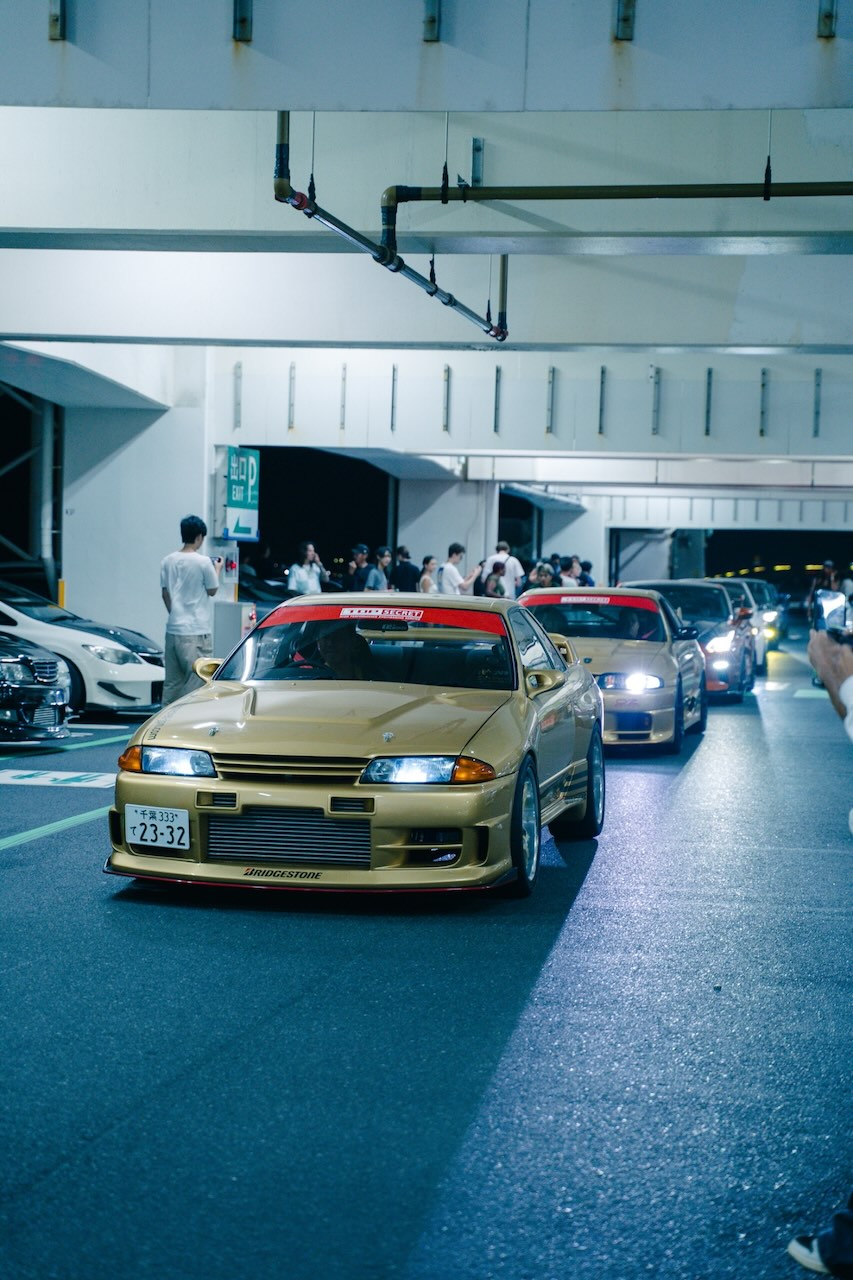
The tour runs three hours. Standard departure is 19:00 from Shibuya, out onto the Shuto Expressway and the Bayshore Route, roughly an hour at Daikoku PA — the parking area under the interchange loop that has become the most famous informal car meet in Japan — then past Tokyo Tower and back into Shibuya by around 22:00. On nights when Daikoku is closed we run to Umihotaru PA instead, out in the middle of Tokyo Bay.
You do not need a driving licence, an international permit or any driving experience, because you ride as a passenger. Message us on WhatsApp at +81 90-8121-3163 or email seiya@hiteup.com with your date and we will tell you honestly which cars are on the schedule that night.
Frequently asked questions
Why is the R32 GT-R called Godzilla?
The nickname came from the Australian motoring press around the R32 GT-R's arrival in Australian touring car racing at the end of the 1980s, and is generally credited to the magazine Wheels. The idea was simple: a monster had come from Japan and was about to flatten everything. The R32 then won the Bathurst 1000 in 1991 and 1992 and the name stuck, first to the R32 and eventually to every GT-R generation since.
How many R32 Skyline GT-Rs were built?
Approximately 43,900 BNR32 Skyline GT-Rs were built between August 1989 and November 1994. That makes the R32 by far the most numerous of the three RB26-powered Skyline GT-Rs — roughly three times the R33 total of about 16,600 and nearly four times the R34 total of about 11,578.
Why is the RB26DETT 2568cc and not a round 2.6 litres?
Because of Group A racing regulations. Group A calculated the class capacity of a turbocharged engine by multiplying its actual displacement by 1.7. Nissan wanted to compete in the class that topped out at 4,500 cc, so the engine had to sit just under 4,500 cc after that multiplier was applied. 2,568 cc multiplied by 1.7 gives about 4,366 cc — comfortably inside the limit with nothing wasted. The odd number is a regulation, not an accident.
Is the R32 GT-R legal to import into the USA?
Yes. The United States 25-year rule allows a vehicle that was never certified for US sale to be imported once it is 25 years old, measured by month of manufacture. R32 GT-R production began in August 1989, so the earliest cars became eligible in 1989 plus 25 years — that is, from August 2014. Production ended in November 1994, so every R32 Skyline GT-R ever built has been eligible since November 2019.
What is the difference between an R32 GT-R and an R32 GT-R V-spec?
The V-spec arrived in February 1993 and added the upgraded ATTESA E-TS Pro all-wheel-drive system with an active limited-slip rear differential, Brembo brakes and 17-inch BBS wheels in place of the standard car's 16-inch wheels and Sumitomo brakes. The V-spec II followed in February 1994 with wider 245-section tyres on the same 17-inch wheels. Engine output was unchanged; the V-spec is a chassis and braking upgrade, not a power upgrade.
How much power does an R32 GT-R actually make?
Nissan advertised 280 PS because Japanese manufacturers had a voluntary agreement not to quote more than that figure for a road car. Independent testing of standard cars has consistently suggested the real output was higher, commonly estimated in the region of 300 to 320 PS at the flywheel. Quoted torque was 353 Nm at 4,400 rpm. The number on the brochure was a marketing ceiling, not an engineering one.
How does ATTESA E-TS all-wheel drive work on the R32?
ATTESA E-TS is a rear-biased electronically controlled all-wheel-drive system. In normal driving the R32 GT-R sends all of its torque to the rear wheels and behaves like a rear-drive car. A control unit reads wheel-speed sensors and a pair of accelerometers mounted under the centre console, and when it detects slip or load transfer it uses a hydraulic multi-plate clutch to feed torque forward — up to a maximum of 50 percent. That is why the R32 feels like a rear-drive car that simply refuses to run out of grip.
What is Super-HICAS on the R32 GT-R?
Super-HICAS is Nissan's four-wheel steering system. It steers the rear wheels by a very small angle — a fraction of a degree in normal use — under electronic control. Initially it can steer them briefly out of phase with the fronts to help the car turn in, then in phase with the fronts to stabilise the car mid-corner. On the R32 GT-R the system is hydraulically actuated. Some tuners remove or lock it for track use, but in standard form it is a large part of why a 1989 all-wheel-drive coupe changes direction as well as it does.
What is an R32 GT-R N1?
The N1 was a homologation model built so Nissan could compete in Japan's N1 endurance racing category. It used a strengthened engine specification with a modified block and metal-backed turbochargers in place of the ceramic-rotor units, and it deleted equipment to save weight — no air conditioning, no audio system, no ABS on the earliest cars, thinner glass and no rear wiper. Production numbers are small and are usually quoted at a little over 200 cars across the R32 run. Genuine N1s are among the most valuable factory R32s.
Is the R32 GT-R better than the R34?
They are different cars rather than better and worse. The R32 is the smallest, lightest and most mechanical of the three RB26 Skyline GT-Rs, at roughly 1,430 kg with a 2,615 mm wheelbase and a five-speed gearbox, and it is the one that actually won the races. The R34 is stiffer, faster, better equipped and vastly more valuable. Drivers who prize feel and involvement often prefer the R32; buyers chasing the cultural icon buy the R34.
Can I ride in an R32 Skyline in Tokyo?
Yes. GTR MAFIA TOKYO runs an R32 Skyline as part of a GT-R and Skyline only fleet in Tokyo. It sits in the Random Plan pool at 26,000 yen per person alongside the R33, R34, R34 GT-R and R35 GT-R. The tour is three hours, departing Shibuya at around 19:00 for Daikoku PA and Tokyo Tower. No driving licence is needed because guests travel as passengers. If you want a guaranteed genuine GT-R rather than a chance of one, the Premium Plan at 36,000 yen per person is the one to book.